By Sarah May, Swansea UCU member
Having come through the intensity of the ‘sprint’ for the ballots on industrial action we’ve just been through, perhaps, like mine, your heart sinks, at the prospect of going through it all again. It’s hard to find the energy to think passionately and positively about industrial action once, never mind twice.
But… as they say on ‘Strictly Come Dancing’ it’s another chance to dance, another chance to build solidarity in the Union and work together to fight for the kind of HE sector we can be proud to work in.
In the last ballot period Swansea Branch focussed messaging on the USS pensions ballot. The branch has been doing a lot of work on this and has gained support in the Senedd Cymru for pushing back against the disastrous 2020 valuation and the awful proposals which ensue. So many of our members are in USS that the cuts of up to 1/3 of our retirement funds are a pretty strong motivator for getting the vote out.
This time around it’s important to talk about the ‘Four Fights’ ballot. This is a separate ballot which came alongside the USS ballot and some members were confused about it. In many branches around the UK, the ‘Four Fights’ ballot was more successful than the USS ballot both in terms of turn out and in support for industrial action. I think this is partly because the ‘Four Fights’ help address the aspects of our employment that impact students most. So the link between standing together for our employment rights and standing with students to build a strong HE sector is much clearer.
So what are the ‘Four Fights’ we are fighting for? Fair Pay, Job Security, Manageable Workloads and Equality. These are obviously the cornerstone of a sustainable Higher Education sector and, yet, we know that we have a long way to go to establish them.
We all know that our salaries have *fallen* nearly 18% against inflation since 2009; that 68% of research academics are on fixed term contracts (with nearly 3.5k on hourly contracts); that almost all of us struggle with workload (and a whopping 86% of staff surveyed have been directed to mental health support in response)… (see UCU four fights infographics below and available here ). All of these things impact marginalised colleagues most (the figures on pay gaps for gender, race and disability are eye watering). But how can we take on these issues?
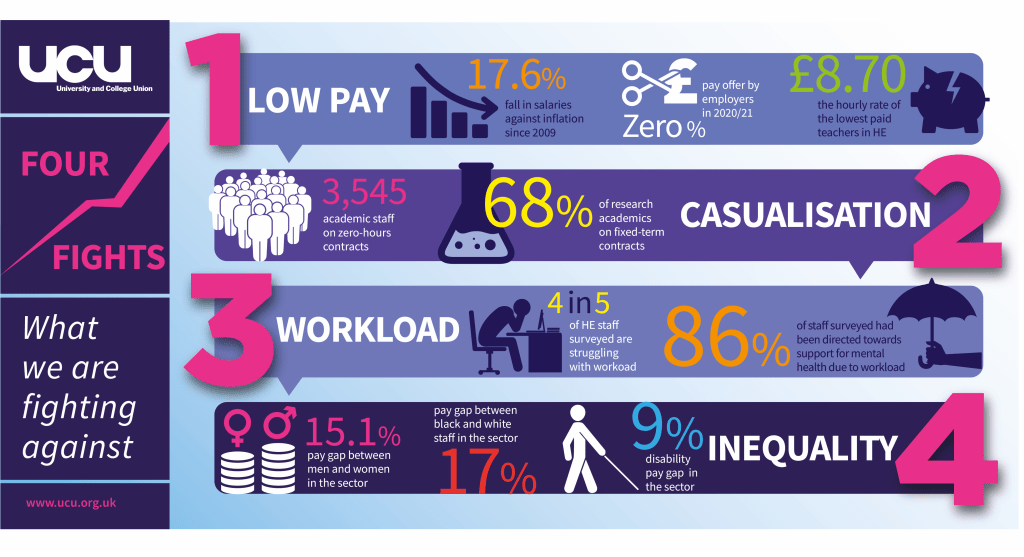
The framing of ‘Four Fights’ was one of the campaign platforms Jo Grady used when she was running for UCU General Secretary and they mark a shift in the Union from one that was seen by many as maintaining the status quo, to one that organises successful campaigns for the education sector we all need. These are issues that were brought up time and again by younger colleagues, by black and other colleagues who experience racism, by those of us who, in our early 50s, are just recovering from a precarious ‘career path’ that has required us to move again and again, by queer colleagues who really need the solidarity of a union.
They also directly impact student experience. A bad pension is a problem for staff, but precarity, inequality and exhaustion are all problems for students. They undermine our efforts to deliver the education our students deserve.
The framing of ‘Four Fights’ has also given us concrete aims that we can organise around. Specific and achievable pay agreements; a move from hourly to fractional contracts and a framework to eliminate precarity; nationally agreed action to address excessive workloads; and real action on equality.
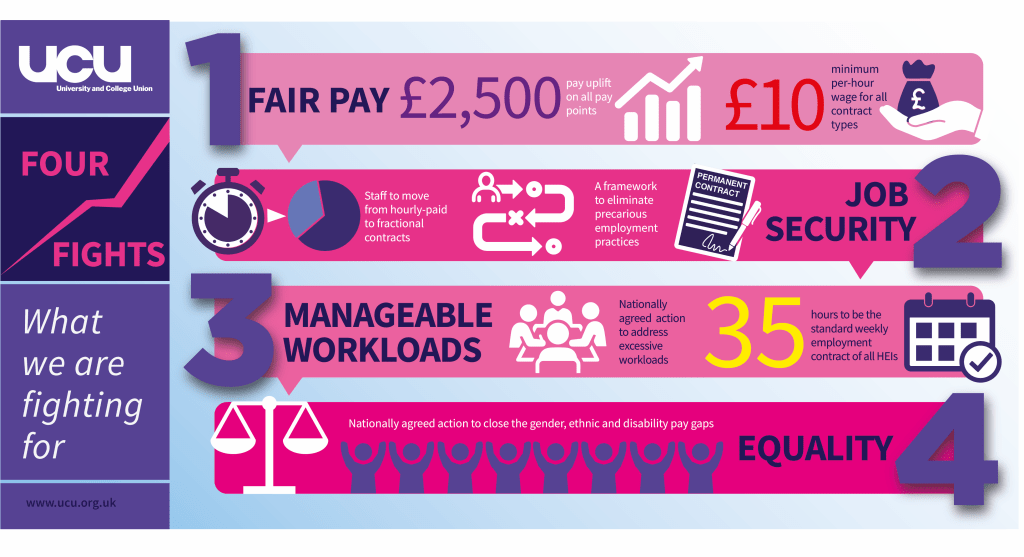
Surely we can’t expect to win so many fights at once? Well we certainly won’t if we don’t try. These are the things we need to do our jobs properly. This is the chance to fight for them. This is the moment to stand in solidarity with colleagues who are asked to sacrifice their wellbeing for the chance to be part of a sector which is crumbling around us. Let’s get the vote out one more time.
 Swansea University UCU