Category Archives: Uncategorized

Vote of no confidence

Swansea University UCU members have voted overwhelming that they have “no confidence” in the leadership of Vice Chancellor Paul Boyle and the direction of the university.

The no confidence vote was triggered by the announcement of a planned £30 million cuts to be made this academic year, £25 million of which will come from staff costs. The £30 million is in addition £50 million cost savings made over the previous two years as part of a “financial sustainability programme” which has seen nearly 400 staff leave the university as part of a voluntary severance scheme alongside the removal over nearly 200 vacancies.

Estelle Hart, President of Swansea UCU said “This vote reflects the anger and frustration felt by our members who are facing yet another year with the threat of redundancy hanging over them, while they are expected to deliver more and more with less and less. The inability of the University to rule out compulsory redundancies or to offer any guarantee that this latest round of cuts will be enough to balance the books is creating an impossible working situation for staff who are not simply concerned with their jobs but with the future of the University itself.

The financial crisis at Swansea, and across the sector, has not been caused by ordinary staff or  students and that they continue to feel its impacts most sharply is completely unacceptable. There must be accountability for those at the top of institutions.”

The text of the vote

Swansea University UCU declares no confidence in the Vice-Chancellor Professor Paul Boyle and the strategic direction taken in response to the continued dire financial position of the University. This approach cleaves to a market doctrine indicating that job losses and spending cuts are the only solution.

We do not believe that the University can solve this crisis through continued rounds of staff and spending cuts, and wholeheartedly reject the idea that a truly successful educational institution can ever exist within a marketised system. We do not have faith that the VC has made the best possible strategic decisions for our staff or students so far, nor do we believe in the ability of the VC to take us on the best path forward.

New university timetabling policy

We have developed some guidance in relation to the university’s new approach to timetabling and flexible working requests. If you have any queries or experience individual issues in this area please get in touch with your department rep or info@swanseaucu.org

What consultation took place?

As part of the consultation process, a UCU representative was part of the timetabling board, led by Steve McVeigh, where decisions were made on the new policy. This occurred between July 2024 and November 2024 until a final policy was agreed by SLT and passed through Senate. 

What was Swansea UCU’s response to the consultation?

UCU continually raised issues in relation to existing policies at Swansea University in terms of Equality, Diversity and Inclusion. Aspects such as the family friendly nature of the new policy, and the emphasis on student experience rather than staff wellbeing was continually raised in the timetabling board, over email and at JCNC. We remain concerned about this new process in terms of EDI, family flexibility, and staff wellbeing. 

What was agreed?

Movements were made to improve the policy in terms of wording, and to allow additional considerations regarding availability, such as the inclusion of regular external research meetings as a possible reason for being unavailable to teach. In addition, the time for staff to correct any issues in timetabling has been extended from 2 weeks to 3 weeks (not including half-term holidays where parents or careers would be disadvantaged in terms of time available to make changes). Nevertheless, UCU remains concerned about the short timeframes, particularly as they are occurring in busy times of the year where exam boards, assessments and annual leave takes place.

What does the new policy mean in practical terms?

Now that the teaching constraints have been removed, those who would like adjustments made to their timetabling (for example due to caring responsibilities) will need to apply for Flexible Working. This means that your working pattern may be amended formally for a 12 month period, which can be used by the timetabling team when designing the timetable for the 2025 – 2026 academic term. 

What should I do if there are issues?

If UCU members experience issues having applied for Flexible Working, they should contact their UCU representative or info@swanseaucu.org as soon as possible with all of the information. We would recommend for members who likely need amended timetables based on childcare to explore Flexible Working Arrangements soon, given there may be a backlog given the substantial change to timetabling. 

Swansea UCU GM, 27 November 2024: financial sustainability and local initiatives

The following is a summary of the branch GM held on the 27th of November, including a motion passed by members.

Swansea UCU GM 27 November 2024

Agenda

  • PGR working group
  • Fixed term staff charter
  • curriculum transformation feedback
  • Financial sustainability programme
  • Motions  

Opening Remarks

Estelle Hart (EH) opens meetings with an overview of agenda. Thanks are minuted to Georgia Bevan who is organising Swansea UCU Palestine Solidarity events, with a workplace day of action on 28th November

Workplace Day of Action – Thursday 28th November

Join us for a day of action on Singleton in support of Palestinians

12pm – Meet in front of Fulton House for solidarity photo

4pm – Meet at campus entrance for banner drop on the bridge

Curriculum Transformation

Thanks are minuted to Patrick Cockburn who is leading on the UCU response to Curriculum Transformation. PC was unable to attend and sent in the following observations:

  1. Only some areas of the university are going through the review this year.
  2. So far this process has been framed as ‘co-created’ with staff and students. This is not the case so far, as our survey data of UCU members shows.
  3. We should try to ensure that the processes from this point forward do involve genuine co-creation and input from staff is taken seriously and fed back up the management chain.
  4. We should insist that curriculum review requirements are reconsidered wherever they generate extra workload that is not accounted for, or where they threaten the viability of programmes.
  5. But we should work with the review process, which could keep workload under control and improve programme quality if done well.
  6. We should insist that we are not simply there to implement plans that have not been co-created.
  7. Talk to your local UCU rep about any concerns you have about how the curriculum review process will affect your area of work. Our response requires coordination and voicing concerns at a local level within units/departments.

Feedback is a powerful tool so all members are urged to fill in curriculum feedback using the following link: https://forms.office.com/e/bVBcqDd56Y

Fixed term staff charter

EH thanks Peter Weck for his work on the Fixed Term staff charter and invites him to speak.

PW explains that the Charter lays out core changes fixed term staff want to see in their conditions. They need signatures to support this charter and pressure management into listening. Once a majority of fixed term staff have signed, more for fixed term staff will be held to determine tactics and next steps.

Please sign the Postdoc/fixed term charter available at this link: https://swanseaucu.org/fixedterm/

You can also download posters to print off and support your colleagues on Fixed Term Contracts – https://swanseaucu.org/fixedterm/

PGR working group

EH praised the development and work of the PGR working group and encouraged people to join. The following link is to a poll to join discussions on PGR issues: https://www.systemli.org/poll/#/poll/dwhvi3HaEB/participation?encryptionKey=5Lhl8LPnfhXNOy1SzlbS3yzk1ZQ7dfrOMIWi3N5D

Service Redesign & Financial Sustainability

EH: As a union, we have taken the line that we should focus on avoiding compulsory redundancy. This falls in line with HQ messaging that compulsory redundancies are a red line for UCU. Therefore, we must discuss the likelihood of balloting and taking industrial action. We need to focus on how we can work together to resist compulsory redundancy and to reach out to other universities. We need to fight now to protect our conditions because the university is nowhere without staff. Time to organise. The union is every single one of us.

EH gives an overview of what has been negotiated so far, and next steps. 

Negotiations and feedback to date have resulted in:

  • Implementation of the pay award
  • Cancellation of major capital projects – Fulton House, £50m
  • Ensured that all professional services staff whose roles are deemed at risk during redesign will be able to access VES even if their redesign period finishes after July
  • Ensured academics whose roles are identified at risk post January 5th will be able to access VES up to July 31st
  • Lobbied for more transparency and more regular updates from SLT and other senior managers – e.g. Additional webinars, local briefings on cuts
  • Engaging independent advice through UCU to look further at university accounts
  • Agreed a suite of additional redundancy avoidance methods: Vacancy management; Redeployment
  • Reviewed and contributed to policy on all parts of the restructure process: pooling; metrics used in selection; no application for current roles
  • There will be new negotiations on any policies related to academic restructure, including selection criteria/metrics.

Ongoing

  • Fortnightly JCNCs
  • Weekly meetings during formal consultation
  • Local meetings e.g. departmental, school level
  • Member queries
  • University Council lobbying
  • Lobbying – national, MEDR, WG
  • University feedback – have your say, meetings

All members can

  • Continue to engage with the university and union: give specific examples of issues; feedback
  • Organising: building density, talk to colleagues, sign up for branch organising activities:  https://forms.office.com/e/D32KwZzRUL

PW also spoke on Branch Organising and Membership density:

We need leverage which comes from membership – need to be well organised and prepared to take action. We need to do work together. We need to be prepared to take industrial action and to take steps to make that a credible threat and successful. We need active members and reps in every department

Link to document discussing organising tactics: https://docs.google.com/document/d/1Ho56Jh3vdMUWNIli0d_QJEW8RxZ-LQCLiajIvMLKG2w/edit?usp=sharing

PW also discusses mapping density – figuring out who is in our department, who should we be talking to, who are the key people.

Motions

This branch notes the ongoing financial sustainability and redesign programme at Swansea University, which has seen over 200 members of staff leave via a voluntary exit scheme, with increased saving targets issued in September 2024.

This branch believes that UK HE is facing a sector-wide financial crisis which must be resolved by government, not borne by staff who are the backbone of universities.

This branch resolves, after 5 January 2025, to seek confirmation that there will be no compulsory redundancies. If the university cannot make this guarantee, the branch will declare a formal dispute with the university.

Proposer: Teresa Phipps

Seconder: Sian Neilson

The motion is proposed by TP and seconded by SN. Discussion around next steps and the January deadline for academic VES. Debate around the term ‘compulsory redundancy’ as a specific legal term and a discussion around the data underpinning the numbers given to departments to cut.

Move to vote:

Motion passes overwhelmingly with 2 votes against and 4 abstentions

Action

EH ask for more detail on the work done to compile the departmental cut

General discussion

  • Impact of the increase on NI employer contributions – likely to be cancelled out by possible tuition fee rise in Wales (in line with England)
  • Criteria to be used for any potential pooling criteria for academics if saving targets are not met. EH assured that these criteria have not yet been decided and will be subject to union negotiation, as has been the case with PS redesign. Ensuring fairness and recognition of protected characteristics.  Members urged to share any messaging shared within schools/faculties
  • Vote of No confidence in Senior management suggested as a tactic

Social for UCU Members

Wednesday 4th December, 4 – 7pm, Pub on the Pond
Swansea UCU backs Fossil Free Careers

Swansea UCU is backing the Fossil Free Careers campaign after a motion (see below) was passed at a GM on Monday 9th January. The campaign calls on Swansea Employability Academy (SEA) to stop actively promoting careers in the oil, gas, and mining industries. This means no longer inviting these companies to attend careers fairs, to advertise their vacancies on careers websites, or to promote them in emails to the student body.

Universities are providing a recruitment pipeline into the extractive industries, and are propping up the companies most responsible for destroying the climate and the planet.  But students across the UK are fighting back and campaigning to get their University careers services to end their relationships with the oil, gas, and mining industries.

Four UK universities have so far committed to fossil free careers. Swansea UCU branch is one of the first branches in the UK to declare support.

More information on the campaign can be found here: https://peopleandplanet.org/fossil-free-careers

A petition for the Swansea Fossil Free Career Campaign can be found here: https://peopleandplanet.org/petitions/fossil-free-careers/fossil-free-careers-swansea

The motion:

This branch notes:


1. Impartial, evidence-based advice offered by HEI careers services is valuable for students and wider society.

2. HEI careers services promoting roles in oil, gas and mining industries is likely contributing to the global climate crisis, and leading students into careers which will decline as we rapidly decarbonise our economies.

3. Congress 2017 passed a motion resolving to “work with members affected by a move to a low carbon economy, other trade unions, and environmentalists” to campaign for a Just Transition.

This branch resolves:

1. To actively work with People & Planet to publicly support the student-led Fossil Free Careers campaign, calling on university careers services to align their operations with sustainability considerations, particularly by declining to promote oil, gas and mining companies.

2. To produce a website statement about this motion and UCU support for this campaign, and amplify the calls to action of it.

Strike News February to April 2022

The first 10 days of action were 14 -18 February, 28 Feb – 2 March. Five more days of strike action by UCU members took place from Monday 28 March to Friday I April over the Universities’ rejection of our demand to compromise on cuts to pensions and refusal to negotiate on pay. We have had an excellent turnout. The camaraderie and support are shown in our newsletters – Please take a look to find out more…

Thanks for all your support!

Pickets Newsletters

Useful Information

What are the Four Fights and why do they matter?

By Sarah May, Swansea UCU member

Having come through the intensity of the ‘sprint’ for the ballots on industrial action we’ve just been through, perhaps, like mine, your heart sinks, at the prospect of going through it all again. It’s hard to find the energy to think passionately and positively about industrial action once, never mind twice.

But… as they say on ‘Strictly Come Dancing’ it’s another chance to dance, another chance to build solidarity in the Union and work together to fight for the kind of HE sector we can be proud to work in. 

In the last ballot period Swansea Branch focussed messaging on the USS pensions ballot. The branch has been doing a lot of work on this and has gained support in the Senedd Cymru for pushing back against the disastrous 2020 valuation and the awful proposals which ensue. So many of our members are in USS that the cuts of up to 1/3 of our retirement funds are a pretty strong motivator for getting the vote out.

This time around it’s important to talk about the ‘Four Fights’ ballot. This is a separate ballot which came alongside the USS ballot and some members were confused about it. In many branches around the UK, the ‘Four Fights’ ballot was more successful than the USS ballot both in terms of turn out and in support for industrial action. I think this is partly because the ‘Four Fights’ help address the aspects of our employment that impact students most. So the link between standing together for our employment rights and standing with students to build a strong HE sector is much clearer.

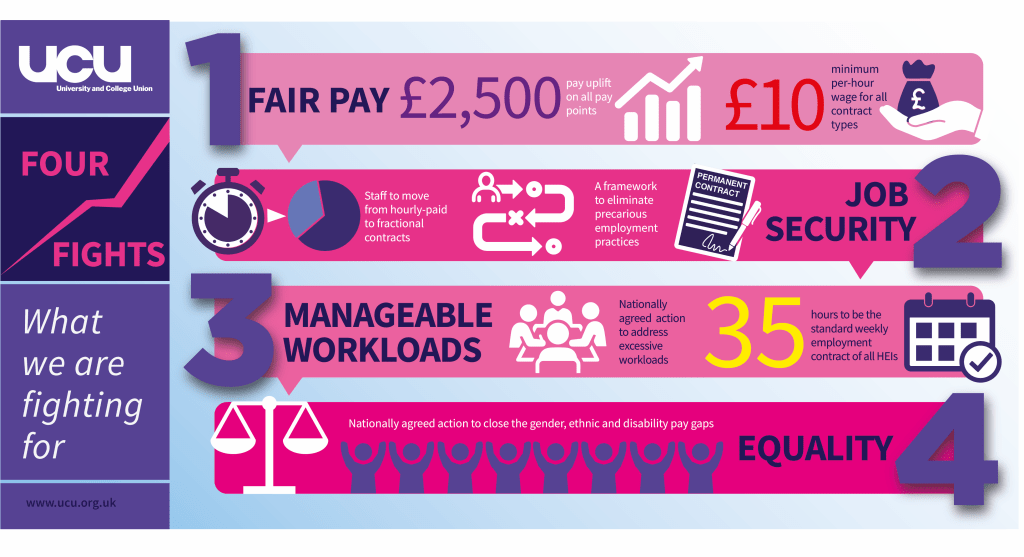
So what are the ‘Four Fights’ we are fighting for? Fair Pay, Job Security, Manageable Workloads and Equality. These are obviously the cornerstone of a sustainable Higher Education sector and, yet, we know that we have a long way to go to establish them.

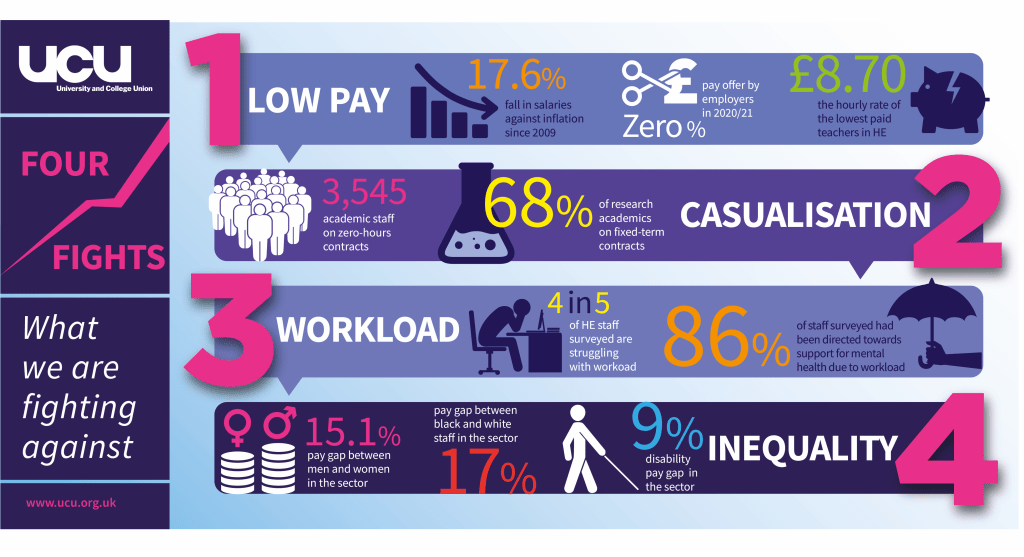
We all know that our salaries have *fallen*  nearly 18% against inflation since 2009; that 68% of research academics are on fixed term contracts (with nearly 3.5k on hourly contracts); that almost all of us struggle with workload (and a whopping 86% of staff surveyed have been directed to mental health support in response)… (see UCU four fights infographics below and available here ).  All of these things impact marginalised colleagues most (the figures on pay gaps for gender, race and disability are eye watering). But how can we take on these issues?

The framing of ‘Four Fights’ was one of the campaign platforms Jo Grady used when she was running for UCU General Secretary and they mark a shift in the Union from one that was seen by many as maintaining the status quo, to one that organises successful campaigns for the education sector we all need. These are issues that were brought up time and again by younger colleagues, by black and other colleagues who experience racism, by those of us who, in our early 50s, are just recovering from a precarious ‘career path’ that has required us to move again and again, by queer colleagues who really need the solidarity of a union.

They also directly impact student experience. A bad pension is a problem for staff, but precarity, inequality and exhaustion are all problems for students. They undermine our efforts to deliver the education our students deserve.

The framing of ‘Four Fights’ has also given us concrete aims that we can organise around. Specific and achievable pay agreements; a move from hourly to fractional contracts and a framework to eliminate precarity; nationally agreed action to address excessive workloads; and real action on equality.

Surely we can’t expect to win so many fights at once? Well we certainly won’t if we don’t try. These are the things we need to do our jobs properly. This is the chance to fight for them. This is the moment to stand in solidarity with colleagues who are asked to sacrifice their wellbeing for the chance to be part of a sector which is crumbling around us. Let’s get the vote out one more time.

Employee rights & fixed-term contracts

There are a number of different types of contract recognised in law, under which an individual agrees to carry out work for another. These include fixed-term contracts which are limited in duration by a specific end date or by completion of particular tasks.

The benefits of fixed-term contracts to employers include temporary access to workers with special skills, or extra labour as and when it is needed. However, in order to safeguard such employees from poor employment practices, they are protected by law, in particular:

  • the right to be treated as favourably as comparable permanent employees (exception – where the difference in treatment can be objectively justified)
  • expiry of a fixed-term contract is recognised in law as a dismissal and fixed-term employees enjoy the same unfair dismissal and redundancy rights as permanent employees
  • fixed-term employees who have been continuously employed by the same employer for four years or more are automatically recognised as permanent, unless the employer can justify otherwise. (This applies to both a single and a series of fixed-term contracts. A gap between a fixed-term contract ending and another starting will not necessarily break continuity)
  • the right to be informed of permanent vacancies available within the organisation

If you would like to know more or have any queries relating to your rights as a fixed-term employee, consider contacting Swansea UCU at info@swanseaucu.org

Alternatively visit this site

Back to Zero – a focus on contract issues

The University is currently seeking to change its use of and payment to staff with zero-hours (or casual) contracts. UCU is concerned that the changes proposed, while presenting certain benefits, may also mean that some staff on these contracts may be paid less than in the past for the same work. We would clearly be opposed to that. Below is a brief guide to zero-hours contracts for everyone who may be affected.  

  • A zero-hours contract is a contact under which an employer has no obligation to provide work and a worker no obligation to undertake work offered  
  • Zero-hours contracts can be beneficial to both employers and workers, e.g. where the employer’s business is uncertain due, for example, to weather conditions or staff absences. They can also benefit a worker who wishes flexibility around their other commitments, e.g. a student. or an individual with caring responsibilities  
  • But there is no doubt that they can also be problematic. A particular area where the use of zero-hours contracts can be a cause for concern is the issue of employment status. Taking a ‘one-size-fits-all’ approach is rarely appropriate, and it can be uncertain whether a person working under a zero-hours contract has the status of an employee or of a worker – a distinction which is important as employees have far broader legal rights than workers, e.g. the right to claim unfair dismissal and/or redundancy pay.  Unfortunately, such confusion has led some employers to exploit the use of zero hours contracts in an attempt to avoid their legal obligations to staff   
  • When deciding whether a zero-hours contract means the individual has the status of an employee or worker it will not just be the wording of the contract that is relevant, but what happens in reality. And if the reality is that the individual is offered and accepts work on a regular basis, then employment tribunals have shown themselves willing to deem the contract to be one of employment  
  • The Government website provides guidance on the “appropriate use”, “inappropriate use”  and “alternatives” to the use of zero hours contracts which Swansea UCU would encourage you to access : GOV.UK: Zero hours contracts: guidance for employers
  • For those who would like to look into this further there is some information available from UCU here and here

Fair and Robust Assessment of Teaching Performance

It would probably be a surprise to many outside HE how small a role teaching traditionally played in academic recruitment and promotion.  The rise of tuition fees has brought with it a change of focus and institutions are now attempting a more rigorous approach to assessing teaching performance.  With staff setting and marking their own assessments and in the absence of external assessment of teaching, there is no obvious ‘gold-standard’ to use.

The current KPI based system in use at Swansea has received widespread criticism.  In an attempt to avoid using subjective assessments from other academics, we instead face the tyranny of bad data.  As a theoretical physicist my own predictions stand or fall in the face of experimental data, but that data must be rigorously measured and analysed, with all biases fully accounted for.  There is a reason why scientific results are presented in papers which describe the experiment and analysis rather than simply stating a number.  Unfortunately, the current KPI system has none of these checks and balances: bias in student feedback is well established, response rates can be minimal and even the rudimentary statistical information recorded at the module level is stripped out to generate a bare number bereft of context or statistical basis.

Following representations from the local UCU committee, the University asked for UCU input into reforming the system.  As discussed at the UCU General Meeting on May 26th, a working group was established to make recommendations for a new system.  Details of the working group’s response can be found here.  Whilst recognising the importance of the student voice, it is vital that all data is presented in context.  To this end we propose a system in which subject experts undertake peer review of teaching and provide an agreed narrative statement to provide context and address the broader picture of teaching contributions.  This approach is similar to ones used elsewhere and provides a much more nuanced and knowledge-based assessment than the current system. All KPIs provide promotion panels with sticks with which to beat applicants if they so wish – it seems to be at the panel’s discretion whether to take a ‘computer says’ approach or not.  This does not seem to us a good way to take this matter forward

Dying to Work

The Dying to Work Campaign, championed by the Trade Union Congress (TUC), and fully supported by UCU, encourages employer organisations to support employees who have a terminal illness at a time of emotional stress, fear and uncertainty. The impact of a terminal illness will vary from individual to individual, but it is important to recognise that for some, they may decide to continue working, as it can be a key part of their coping approach to receiving a terminal diagnosis, as well as to meet their financial security needs for their loved ones.

The Dying to Work Charter ensures that any organisation that is a signatory has agreed to ensure these people are fully supported during this time with respect, are able  to access all employment in service financial benefits, and will not have their employment terminated on the basis they have a terminal condition. Essentially, the Dying to Work Charter promotes an individual’s choice around various options as to how they may want to continue with their work. UCU are committed to ensuring that every person who has received a terminal diagnosis is supported and their individual choices are respected within the work environment.

There are various other Welsh organisations that are signatories to the Charter, such as Public Health Wales, Natural Resources Wales, Adult Learning Wales, Health Education & Improvement Wales, Hywel Dda, University Health Board Cardiff and Vale University Health Board, Wrexham Glyndwr University, Gower College Swansea, Swansea Council and Neath Port Talbot County Borough Council. Whilst Swansea University (SU) is currently not a signatory to the Dying to Work Charter, it is important to recognise that as an organisation it does have several policies and procedures that align to the key principles outlined in the charter.

The UCU Swansea Branch are currently liaising with the other Swansea University Trade Unions as well as engaging with Swansea University to:

  • Review SU current policies and procedures to determine how they align to the principles of the Dying To Work Charter
  • Detail how current SU support procedures and policies can be collated into a Dying to Work Employee Assistance Programme that will clearly describe the support that Swansea University can provide to any colleague with a terminal illness, including access to counselling, occupational health support and financial advice.
  • Explore, detail and develop the provision of training to line managers and all HR staff on how to support colleagues with terminal illness to continue to work, including how any recommended adaptations to work arrangements can be implemented and to signpost colleagues to the various support services offered by Swansea University and other external organisations.

These are key components of the Charter, and it is hoped that the outcome from this collaborative working will form the basis for Swansea University to formally adopt the Dying to Work Charter.  This will ensure that our colleagues who receive a terminal diagnosis are supported with dignity and respect, without undue financial loss at a time when they, and their families, may need it most.