Pensions insights: an expert discussion

A recent pensions webinar organised by Cambridge University gave a really good insight into both sides of the pensions dispute and in particular into the reasons why the tendency to risk aversion is so strong on the USS side. 

What came out clearly, however, was that, under the existing regime, only in the distant future (towards end of 21st century) is there even a modest chance of the fund being unable to deliver on its pensions promises and that, looking back into the past, modelling based on the last 120 years does not support the need felt by USS to derisk so drastically – unless that is, said one of the speakers, ‘a general decimation of humanity’ takes place (i.e. via global warming or something) and in that case USS would be trying to ‘protect us from the unprotectable’. 

What was reassuring too was that this was not some kind of UCU ‘propaganda’ exercise. It was introduced by the Vice Chancellor of Cambridge University, chaired (very well) by Chris Havergill, Times Higher Education pensions reporter, and contributed to by the Chief Financial Officer of Cambridge University and by acknowledged academic pensions experts from Imperial College and Cambridge University Business School.  And the whole thing was conducted in a spirit of attempted understanding and conciliation between the sides. 

It is publicly available for all to watch : here is the link

Letter from UCU to Swansea University on the USS dispute  

As Swansea University is aware, UCU is in dispute with the University employer over pensions. We would urge Swansea University, whose representative body for pensions is UUK, to instruct their representatives to help to resolve this dispute.  

The UCU demands are reasonable, affordable and straightforward to implement. They would strengthen the Swansea University’s strategic plan, they will lead to improvements in all areas of our work, including the University KPIs, staff wellbeing and the student experience. They will improve the international reputation of the entire sector.  

Swansea University UCU asks that the University publicly call on UUK to meet the reasonable and easily achievable demands in the UCU dispute letter.  

The letter to UUK (on USS) 8 November 2021 calls on UUK to consult employers on:  

· Withdrawing their current un-agreed detrimental changes to members’ pensions;  

· Whether they would be prepared to pay higher contributions for fixed period of time to allow a negotiated settlement; and  

· To call publicly for a 2021 valuation.  

Background on USS  

Against the backdrop of repeated misleading statements from UUK, the UUK cuts to USS pensions, which are significant and which will impact most severely on the next generation of university staff, were voted through by JNC Chair’s vote on 31 August 2021.  

UCU has since written to USS CEO Bill Galvin, outlining a legal case relating to serious grounds for questioning the rationality and reasonableness of the decision-making of the trustee.  

However, the March 2020 valuation has now been submitted to the Pensions Regulator (TPR), ahead of the legally required 60 day consultation with members. The valuation date of March 2020 was an extreme low point due to the initial impact of the pandemic, with funding positions of DB schemes falling dramatically at March 2020, then recovering significantly.  

Views on the 2020 valuation  

The following quotes support the widely held view that the 2020 valuation gives a highly pessimistic and misleading measure of the financial health of the scheme.  

… more disturbance from striking academics. It is easy to condemn them, but I do not. They are the victims of unduly risk-averse decision making at the Universities Superannuation Scheme, under the influence of misconceived regulation. [Martin Wolfe, Chief Economics Commentator, Financial Times, 14 November 2021] 

31 March 2020 was a poor date to carry out a valuation compared with market conditions at 31 March 2018. However, the position has since improved for most schemes. … Given the exceptional circumstances at 31 March 2020, there is a danger that too much can be read into the conclusions of a valuation at that date. [UUK Actuaries AON, April 2021]  

The 2020 valuation methodology is described as ‘misleading’ and a ‘hall of mirrors’ by UUK’s actuary [AON report, April 2021]. The valuation is described by UUK as ‘unjustified’, ‘unnecessary’, and ‘unaffected by the evidence presented’ [public letter from UUK to USS, May 2021].  

In the case of the USS, the right option is to make conservative, but not insanely pessimistic, assumptions and conclude that it is healthy. [Martin Wolf, Chief Economics Commentator, Financial Times, 27 June 2021]  

The level of cuts and the cost of maintaining benefits  

The UUK proposals to cut benefits have three parts  

· Reduction in accrual rate from 1/75 to 1/85  

· Cap on interest at CPI of 2.5% (currently capped at 5% plus half from 5%-10%)  

· Lowering of DB threshold from circa £60k to £40k  

Since May 2021, UUK has issued consistently misleading statements on the level of cuts and the cost of maintaining benefits throughout UUK consultations.  

For example, the USS modeller makes it clear that the reduction in future guaranteed pension income is significant. The cuts range between 17% and 48% for Consumer Price Index of 2.5%. If CPI is 3.5% the cuts range between 28% and 56%. The cuts hit the youngest and the next generation the hardest.  

As UCU stated in its dispute letter of 22 September 2021, the level of cuts to the future guaranteed pension for a typical member are 35%, and this reduced to cuts of 23% when the non-guaranteed DC is included.  

The UUK proposals will mean a USS member aged 37 earning £41,526 (the current starting salary for a lecturer in many institutions) can be expected to go on to build up an annual guaranteed pension of £12,170 if they continue to work full time in the sector until age 66. This compares with the £18,857 annual income which they would build up under the existing arrangement. The same 35% cut would also apply to the guaranteed cash lump sum which the member would receive when they retire. Even when the expected extra cash is included into this member’s DC pension pot and then converted into USS DB pension, the cut from the UUK proposals remains at 23% of pension income.  

UUK has consistently briefed against this estimate from UCU’s actuaries, with UUK’s Head of Pensions writing to UCU explicitly writing to VCs to say this statement is ‘untrue’.  

The cost to Universities of retaining benefits  

The cost of maintaining current benefits to the end of the University financial year would be less than previously budgeted by Universities under their 2018 Schedule of Contribution October rises.  

Under the backstop, retaining full benefits, the cost is £1m, far less than budgeted by most and significantly below the much larger amount estimated in Universities’ risk registers.  

These are costs that are affordable to Universities up to October 2022 and that maintaining full benefits under the backstop until October 2022 would allow space for negotiation and a new valuation.  

Given that the UUK proposal for cuts to future service benefits are clearly and visibly not the best that can be achieved against appropriate assumptions, we recommend that University publicly calls on UUK to meet the UCU demands.  


 Swansea University UCU  
What are the Four Fights and why do they matter?

By Sarah May, Swansea UCU member

Having come through the intensity of the ‘sprint’ for the ballots on industrial action we’ve just been through, perhaps, like mine, your heart sinks, at the prospect of going through it all again. It’s hard to find the energy to think passionately and positively about industrial action once, never mind twice.

But… as they say on ‘Strictly Come Dancing’ it’s another chance to dance, another chance to build solidarity in the Union and work together to fight for the kind of HE sector we can be proud to work in. 

In the last ballot period Swansea Branch focussed messaging on the USS pensions ballot. The branch has been doing a lot of work on this and has gained support in the Senedd Cymru for pushing back against the disastrous 2020 valuation and the awful proposals which ensue. So many of our members are in USS that the cuts of up to 1/3 of our retirement funds are a pretty strong motivator for getting the vote out.

This time around it’s important to talk about the ‘Four Fights’ ballot. This is a separate ballot which came alongside the USS ballot and some members were confused about it. In many branches around the UK, the ‘Four Fights’ ballot was more successful than the USS ballot both in terms of turn out and in support for industrial action. I think this is partly because the ‘Four Fights’ help address the aspects of our employment that impact students most. So the link between standing together for our employment rights and standing with students to build a strong HE sector is much clearer.

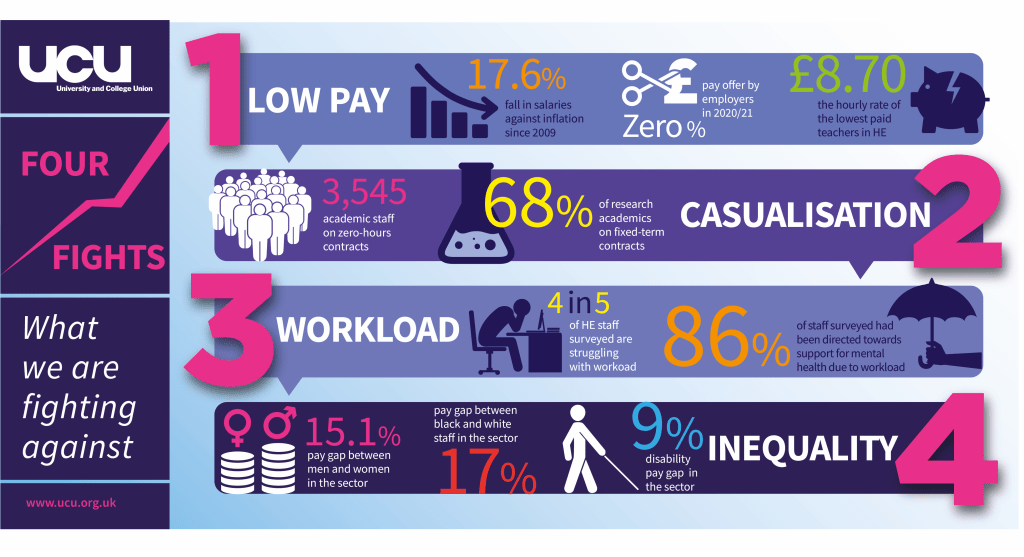
So what are the ‘Four Fights’ we are fighting for? Fair Pay, Job Security, Manageable Workloads and Equality. These are obviously the cornerstone of a sustainable Higher Education sector and, yet, we know that we have a long way to go to establish them.

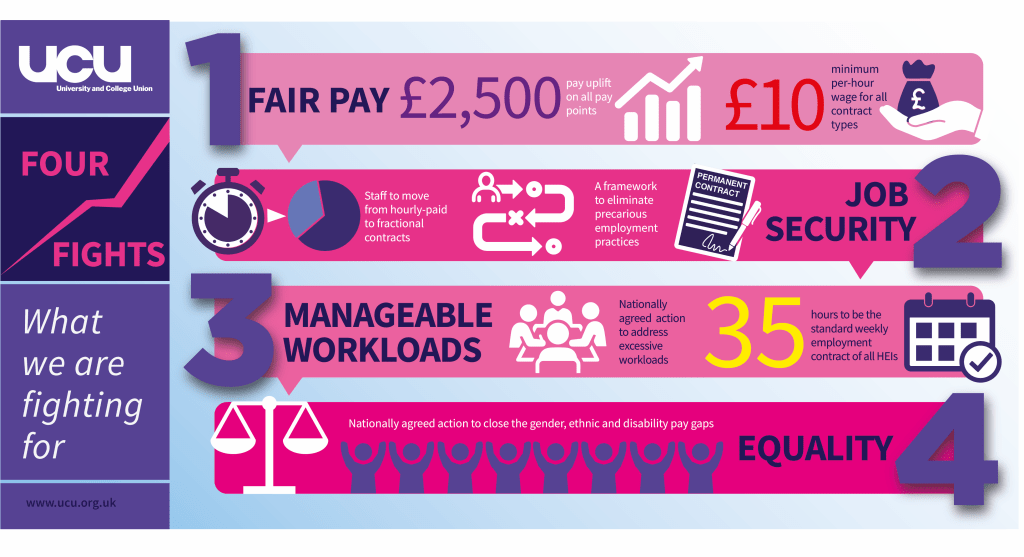
We all know that our salaries have *fallen*  nearly 18% against inflation since 2009; that 68% of research academics are on fixed term contracts (with nearly 3.5k on hourly contracts); that almost all of us struggle with workload (and a whopping 86% of staff surveyed have been directed to mental health support in response)… (see UCU four fights infographics below and available here ).  All of these things impact marginalised colleagues most (the figures on pay gaps for gender, race and disability are eye watering). But how can we take on these issues?

The framing of ‘Four Fights’ was one of the campaign platforms Jo Grady used when she was running for UCU General Secretary and they mark a shift in the Union from one that was seen by many as maintaining the status quo, to one that organises successful campaigns for the education sector we all need. These are issues that were brought up time and again by younger colleagues, by black and other colleagues who experience racism, by those of us who, in our early 50s, are just recovering from a precarious ‘career path’ that has required us to move again and again, by queer colleagues who really need the solidarity of a union.

They also directly impact student experience. A bad pension is a problem for staff, but precarity, inequality and exhaustion are all problems for students. They undermine our efforts to deliver the education our students deserve.

The framing of ‘Four Fights’ has also given us concrete aims that we can organise around. Specific and achievable pay agreements; a move from hourly to fractional contracts and a framework to eliminate precarity; nationally agreed action to address excessive workloads; and real action on equality.

Surely we can’t expect to win so many fights at once? Well we certainly won’t if we don’t try. These are the things we need to do our jobs properly. This is the chance to fight for them. This is the moment to stand in solidarity with colleagues who are asked to sacrifice their wellbeing for the chance to be part of a sector which is crumbling around us. Let’s get the vote out one more time.

Employee rights & fixed-term contracts

There are a number of different types of contract recognised in law, under which an individual agrees to carry out work for another. These include fixed-term contracts which are limited in duration by a specific end date or by completion of particular tasks.

The benefits of fixed-term contracts to employers include temporary access to workers with special skills, or extra labour as and when it is needed. However, in order to safeguard such employees from poor employment practices, they are protected by law, in particular:

  • the right to be treated as favourably as comparable permanent employees (exception – where the difference in treatment can be objectively justified)
  • expiry of a fixed-term contract is recognised in law as a dismissal and fixed-term employees enjoy the same unfair dismissal and redundancy rights as permanent employees
  • fixed-term employees who have been continuously employed by the same employer for four years or more are automatically recognised as permanent, unless the employer can justify otherwise. (This applies to both a single and a series of fixed-term contracts. A gap between a fixed-term contract ending and another starting will not necessarily break continuity)
  • the right to be informed of permanent vacancies available within the organisation

If you would like to know more or have any queries relating to your rights as a fixed-term employee, consider contacting Swansea UCU at info@swanseaucu.org

Alternatively visit this site

Back to Zero – a focus on contract issues

The University is currently seeking to change its use of and payment to staff with zero-hours (or casual) contracts. UCU is concerned that the changes proposed, while presenting certain benefits, may also mean that some staff on these contracts may be paid less than in the past for the same work. We would clearly be opposed to that. Below is a brief guide to zero-hours contracts for everyone who may be affected.  

  • A zero-hours contract is a contact under which an employer has no obligation to provide work and a worker no obligation to undertake work offered  
  • Zero-hours contracts can be beneficial to both employers and workers, e.g. where the employer’s business is uncertain due, for example, to weather conditions or staff absences. They can also benefit a worker who wishes flexibility around their other commitments, e.g. a student. or an individual with caring responsibilities  
  • But there is no doubt that they can also be problematic. A particular area where the use of zero-hours contracts can be a cause for concern is the issue of employment status. Taking a ‘one-size-fits-all’ approach is rarely appropriate, and it can be uncertain whether a person working under a zero-hours contract has the status of an employee or of a worker – a distinction which is important as employees have far broader legal rights than workers, e.g. the right to claim unfair dismissal and/or redundancy pay.  Unfortunately, such confusion has led some employers to exploit the use of zero hours contracts in an attempt to avoid their legal obligations to staff   
  • When deciding whether a zero-hours contract means the individual has the status of an employee or worker it will not just be the wording of the contract that is relevant, but what happens in reality. And if the reality is that the individual is offered and accepts work on a regular basis, then employment tribunals have shown themselves willing to deem the contract to be one of employment  
  • The Government website provides guidance on the “appropriate use”, “inappropriate use”  and “alternatives” to the use of zero hours contracts which Swansea UCU would encourage you to access : GOV.UK: Zero hours contracts: guidance for employers
  • For those who would like to look into this further there is some information available from UCU here and here

Fair and Robust Assessment of Teaching Performance

It would probably be a surprise to many outside HE how small a role teaching traditionally played in academic recruitment and promotion.  The rise of tuition fees has brought with it a change of focus and institutions are now attempting a more rigorous approach to assessing teaching performance.  With staff setting and marking their own assessments and in the absence of external assessment of teaching, there is no obvious ‘gold-standard’ to use.

The current KPI based system in use at Swansea has received widespread criticism.  In an attempt to avoid using subjective assessments from other academics, we instead face the tyranny of bad data.  As a theoretical physicist my own predictions stand or fall in the face of experimental data, but that data must be rigorously measured and analysed, with all biases fully accounted for.  There is a reason why scientific results are presented in papers which describe the experiment and analysis rather than simply stating a number.  Unfortunately, the current KPI system has none of these checks and balances: bias in student feedback is well established, response rates can be minimal and even the rudimentary statistical information recorded at the module level is stripped out to generate a bare number bereft of context or statistical basis.

Following representations from the local UCU committee, the University asked for UCU input into reforming the system.  As discussed at the UCU General Meeting on May 26th, a working group was established to make recommendations for a new system.  Details of the working group’s response can be found here.  Whilst recognising the importance of the student voice, it is vital that all data is presented in context.  To this end we propose a system in which subject experts undertake peer review of teaching and provide an agreed narrative statement to provide context and address the broader picture of teaching contributions.  This approach is similar to ones used elsewhere and provides a much more nuanced and knowledge-based assessment than the current system. All KPIs provide promotion panels with sticks with which to beat applicants if they so wish – it seems to be at the panel’s discretion whether to take a ‘computer says’ approach or not.  This does not seem to us a good way to take this matter forward

Dying to Work

The Dying to Work Campaign, championed by the Trade Union Congress (TUC), and fully supported by UCU, encourages employer organisations to support employees who have a terminal illness at a time of emotional stress, fear and uncertainty. The impact of a terminal illness will vary from individual to individual, but it is important to recognise that for some, they may decide to continue working, as it can be a key part of their coping approach to receiving a terminal diagnosis, as well as to meet their financial security needs for their loved ones.

The Dying to Work Charter ensures that any organisation that is a signatory has agreed to ensure these people are fully supported during this time with respect, are able  to access all employment in service financial benefits, and will not have their employment terminated on the basis they have a terminal condition. Essentially, the Dying to Work Charter promotes an individual’s choice around various options as to how they may want to continue with their work. UCU are committed to ensuring that every person who has received a terminal diagnosis is supported and their individual choices are respected within the work environment.

There are various other Welsh organisations that are signatories to the Charter, such as Public Health Wales, Natural Resources Wales, Adult Learning Wales, Health Education & Improvement Wales, Hywel Dda, University Health Board Cardiff and Vale University Health Board, Wrexham Glyndwr University, Gower College Swansea, Swansea Council and Neath Port Talbot County Borough Council. Whilst Swansea University (SU) is currently not a signatory to the Dying to Work Charter, it is important to recognise that as an organisation it does have several policies and procedures that align to the key principles outlined in the charter.

The UCU Swansea Branch are currently liaising with the other Swansea University Trade Unions as well as engaging with Swansea University to:

  • Review SU current policies and procedures to determine how they align to the principles of the Dying To Work Charter
  • Detail how current SU support procedures and policies can be collated into a Dying to Work Employee Assistance Programme that will clearly describe the support that Swansea University can provide to any colleague with a terminal illness, including access to counselling, occupational health support and financial advice.
  • Explore, detail and develop the provision of training to line managers and all HR staff on how to support colleagues with terminal illness to continue to work, including how any recommended adaptations to work arrangements can be implemented and to signpost colleagues to the various support services offered by Swansea University and other external organisations.

These are key components of the Charter, and it is hoped that the outcome from this collaborative working will form the basis for Swansea University to formally adopt the Dying to Work Charter.  This will ensure that our colleagues who receive a terminal diagnosis are supported with dignity and respect, without undue financial loss at a time when they, and their families, may need it most.

USS PENSIONS UPDATE

In the Emergency General Meeting we called on pensions earlier this month to discuss the developing situation of potential USS pension detriment, we pointed out the deficiencies of the survey sent round to USS members by the University as part of the Universities UK (UUK) consultation of its members, i.e. the employers. The survey seemed designed to achieve a pre-determined result and there was considerable support for the idea that we run our own parallel survey asking different more relevant questions. So we did just that and sent the survey round later the same week. You can see the results in statistical form and with brief analysis of the statistics and members’ additional comments here

The standout feelings of members were:

 1: that the USS scheme’s secure defined benefit nature was highly valued;

 2.: that there was opposition to the kind of two-tier pension being proposed where lower paid staff would have defined contribution conditions and higher paid ones would have defined benefit;

 3: that the death and incapacity benefits of a defined benefit pension were highly important;

 4: that significant governance reform was required by USS in order to achieve a realistic valuation of the pension fund.

The scheme’s current value stands at £80B+, with its non low-risk assets performing extremely well.

We shared the outcome of our own survey with the University and met with the Director of Finance who had been tasked to draw up the University’s response to the UUK consultation. The Director of Finance then shared her own draft report with us and asked for our feedback. This was useful engagement and cooperation and I’m pleased to say that her report showed that she had taken on board some important elements of our case. So, for example, her report begins as follows:

“The University’s first position is that it believes that the valuation methodology takes too prudent an approach and that the underlying assumptions should be revisited. This would be our preference as a way forward and we would like to see UUK continue to press the USS trustee to review the assumptions.

Additionally, we believe both The Pensions Regulator and the USS Trustee are taking an unnecessarily prudent approach to the covenant strength of the sector, on the basis of one exit from the Scheme. There is no history of universities becoming insolvent and there is little evidence to suggest that this is likely in future.”

It goes on later:

There is no doubt that the way that this valuation process has been conducted has been wholly unsatisfactory and a review of where the shortfalls and failings have been is absolutely essential.

This recognition of the flawed methodology being adopted by USS is a positive start and we are continuing to engage with the University, hopefully with a view to an agreed joint statement on pensions, as has happened already at several other institutions.

More widely, we understand that UUK is concerned that its members (i.e. the University managements) are not unified in their consultation responses and are not uniformly confirming UUK’s line of basic acceptance of USS’s assumptions even if proposing a different but in many ways equally detrimental way of putting them into practice. So there’s good deal of questioning and challenging going on by Universities, influenced at least partly by strong responses from UCU, both locally and nationally. The grapevine even says that USS is now concerned that they may face opposition from UUK and have been attempting some not very subtle interventions and potentially meddling in industrial relations, which is inappropriate. 

Looking forward, the employer consultation has now closed and there will be a 2-3 week write-up period and then a consultation with UCU. Then, on the UCU side, the matter will be discussed by our Superannuation Working Group and then go to the JNC, the joint employer-employee negotiating committee, and we can expect a final proposal from UUK in July or August.

As for UCU, we’ll have to explore every avenue in the campaign we wage. It’s unlikely that reason, logic and fairness will be enough. We’ll need to look at. for example, things like conditional indexation, a possible legal challenge to USS on the grounds that the Trustee is not acting in the fiduciary interest of scheme members, and, if the worst comes to the worst and very reluctantly, even industrial action. Short of that we need to push for commitments from employers on extending covenant support, governance reform, and lobbying for regulatory change. We believe USS can provide members with good pensions by ensuring that a significant majority of its holdings are in assets that generate relatively high returns. It should stop and ultimately reverse its current tendency to hold an increasing proportion of low-yield, fixed-income assets such as gilts. As for UUK, we want it to showing more support for and confidence in the scheme as a vital element in the sector. Above all we want to see UUK and UCU working together to end the cycle of dispute over pensions.

Howard Moss

Swansea UCU Pensions Rep

Student feedback in PDRs- addressing concerns

In response to concerns expressed by members about the role of student feedback in PDRs, UCU has been in communication with the University to raise those concerns. They include such factors as low response rate from students and potential gender discrimination in the feedback – see attached letter

As a result the University, as stated in the response we have received from Pro-Vice Chancellor Martin Stringer, has agreed to review the whole process after Easter and in the meantime we have proposed that the University carry out an ethical review of this issue and also an equality impact assessment.

Why unions are important

UCU Local Committee member, Mahaboob Basha, has written an article just published in the South Wales Evening Post, arguing strongly for increased public investment by governments and highlighting the vital role played by trade unions in defending jobs and maintaining living standards: See the article here


Transcript:-

Yesterday saw the start of Heart Unions Week,  which runs until February 14. It’s a  chance for active campaigners to  tell the story about why unions are  important for everyone at work and  encourage people who aren’t yet in  a union to join. Here, Dr  Mahaboob Basha explains  why the world would be different without unions.

The capitalist world came to an abrupt halt in March last year. The global economy shut, borders closed, and countries went into lockdown.
Now, as many countries begin a cautious reopening, the shape of the new world is yet to be defined. But the coronavirus crisis seems like a definitive break, a full stop.
The pandemic perfectly exposes globalisation, and its long, opaque supply chains.
Everything is connected to everything else, but it’s not always clear how, or what we can do to influence the flow of money, power and information.
This is the environment trade unions have operated in since the 1980s attempting to find local solutions to complex global problems, and learning to confront formless, footloose capital through growing international cooperation.
Today most can comfortably perform their white-collar jobs from home, with the space and equipment they need.
Working class people have borne the brunt of the crisis, the health workers and hospital cleaners who have had to go to work without protective equipment.
The supermarket, transport, cleaning, and delivery workers, until recently disparaged as low skilled, have suddenly been recognised as the essential glue that holds our societies together.
Further inequalities have been exposed there are more women than men in dangerous frontline jobs, and more people of colour.
Those who were already vulnerable in this economy have been made more vulnerable.
Unions have responded well, mobilizing their activists and resources to defend working people.
The furlough schemes that provide support for workers are the result of union campaigns, as is the pressure to provide PPE.

Unions have highlighted the essential role played by underpaid workers in key areas of the economy.
By negotiating pay during lockdown, millions of workers have been able to shelter safely, slowing the spread of the virus and saving countless lives.
Unions have also been at the forefront of providing public health advice, and distributing sanitiser, masks, and gloves.
But the initial shape of the post-Covid-19 world is not good, at least if you’re a trade unionist.
It is devastating to confront the carnage of lost jobs, recognizing that each one was supporting a family and a community. But we have to resist the conclusion that this carnage is the inevitable consequence of the coronavirus crisis
After World War Two, Europe lay in ruins.
Money was found to reconstruct the continent, and that rebuilding laid the groundwork for the welfare state that was so successful until it was torn apart by Thatcher neoliberal counter-revolution.
Firstly, employers and right-wing governments are using coronavirus as an excuse to force through changes they would not be able to achieve in normal times.
Secondly, many companies are cynically using the health crisis as an opportunity to lay off workers they wanted to get rid of anyway, while taking bail out money from governments.
Finally, that coronavirus dramatically accelerated processes that were already underway.
We also know that fast fashion is not sustainable. We know that we need to transition from a fossil fuel-based economy to a green economy. We know there is no long-term future in oil or coal.

We are clear that climate change requires a very different economy.
What has been missing so far is political will.
Most governments have been content to take a hands-off approach, hoping that a few gentle nudges will be enough to entice the private sector to invest in transformation
Coronavirus showed that it is possible for governments to act quickly and boldly, to take decisions that will have dramatic consequences.
Tory governments that spent years complaining of empty coffers suddenly found billions to stop the collapse of society.
Millions of workers were placed on furlough, receiving public money, and companies received financial support.
These responses have reignited conversations around Universal Basic Income, the value of essential and frontline workers and many other aspects of the old normal that were taken for granted.
The recovery from Covid-19 must be another moment like this. Governments and companies must find the resources to rebuild a just and green economy.
We need a globally coordinated effort to create a new deal.
We need more than bailouts. We need massive public investment in the future. Our role as trade unionists is to demand this, to argue for it, to promote our policies, and to strike for the future if we must.

Dr. Mahaboob Basha was awarded the British Empire Medal last year for services to the community in Sketty. He is an is active University College Union (UCU) branch member of Swansea University, the Unite Swansea Services and Energy Branch of South West and Mid Wales.